
Tourism led conservation has a massive unrealized opportunity for channeling guest goodwill towards sustainable funding.
In 2025, the four East African neighbors; Kenya, Tanzania, Uganda and Rwanda collectively welcomed roughly 8 million international visitors with a meaningful proportion of those travelers coming into direct contact with the extraordinary landscapes, wildlife and communities that make the region one of the world's great travel destinations. A sizable portion of those guests describe their experiences as life changing, imparting on them a strong desire to give back.
The 75% signal
Research into visitor willingness to give provides a useful indication of this latent goodwill. One empirical study at Ethiopia's Bale Mountains National Park found that 75% of visitors were willing to contribute to a dedicated conservation fund, over and above the existing park entry fee.
It would be wrong to extrapolate a single study into a 75% conversion rate across East Africa, but the finding illustrates something that anyone who has spent time around conservation led tourism instinctively understands: the guest experience creates an unusually powerful moment of goodwill. The problem is that very little infrastructure exists to systematically convert that goodwill into economic flows.
Let's do the math
Consider the scale of the opportunity as a simple scenario. 8 million international arrivals represent roughly 3.2 million traveling parties, assuming an average party size of 2.5 people. If 75% of those parties were ultimately willing to support conservation or community initiatives, that represents 2.4 million prospective giving relationships.
Capture just $50 per willing traveling party and the result is $120 million in potential annual funding largely left unrealized currently.
That is not a forecast. It is an illustration of what becomes possible when an enormous volume of guest goodwill encounters the right infrastructure. $50 is only the first transaction. The far greater opportunity is converting a guest who gives once into someone who remains connected to a conservancy, community or cause for three, five or ten years.
The Missing Connective Tissue
What is needed for unlocking this potential is the right infrastructure that can bring together guests, operators and conservationists into flowing rails of generosity.
Prior to Shukran, I built a nonprofit organization from scratch, managing to raise $3.5 million in over six years. One of our biggest fundraising gaps was the lack of immersive personal experiences for our donors all who lived in the US while the work was happening in Nairobi. I would have done anything to have them walk the hallways at Impact Africa Network for a firsthand experience of the work. It would have made a dramatic difference in giving decisions.
Travel and conservation have the opposite problem. The immersive experience already exists. Guests have just spent days seeing the wildlife, meeting the people and experiencing the landscapes firsthand. The emotional connection has already been created. The giving intent is primed. What is needed is a well designed infrastructure that can engage that intent at source and channel it to the appropriate cause.
My experience with donor cultivation exposed me to the rigors of fundraising, and is the foundation underwriting our thesis and design principles for our Donor Engagement Platform.
Generosity Infrastructure for Travel and Hospitality
We decided to build the Donor Engagement Platform not because the world needs another fundraising platform. There are already plenty of those. What we saw missing was infrastructure designed specifically around how travel and hospitality actually work.
In this industry, the tour or hospitality operator owns the guest relationship. That relationship is built on trust, stewardship and a shared experience of place. Operators are therefore uniquely positioned to direct guest attention toward the conservation and community initiatives connected to that experience.
DEP is designed around that reality.
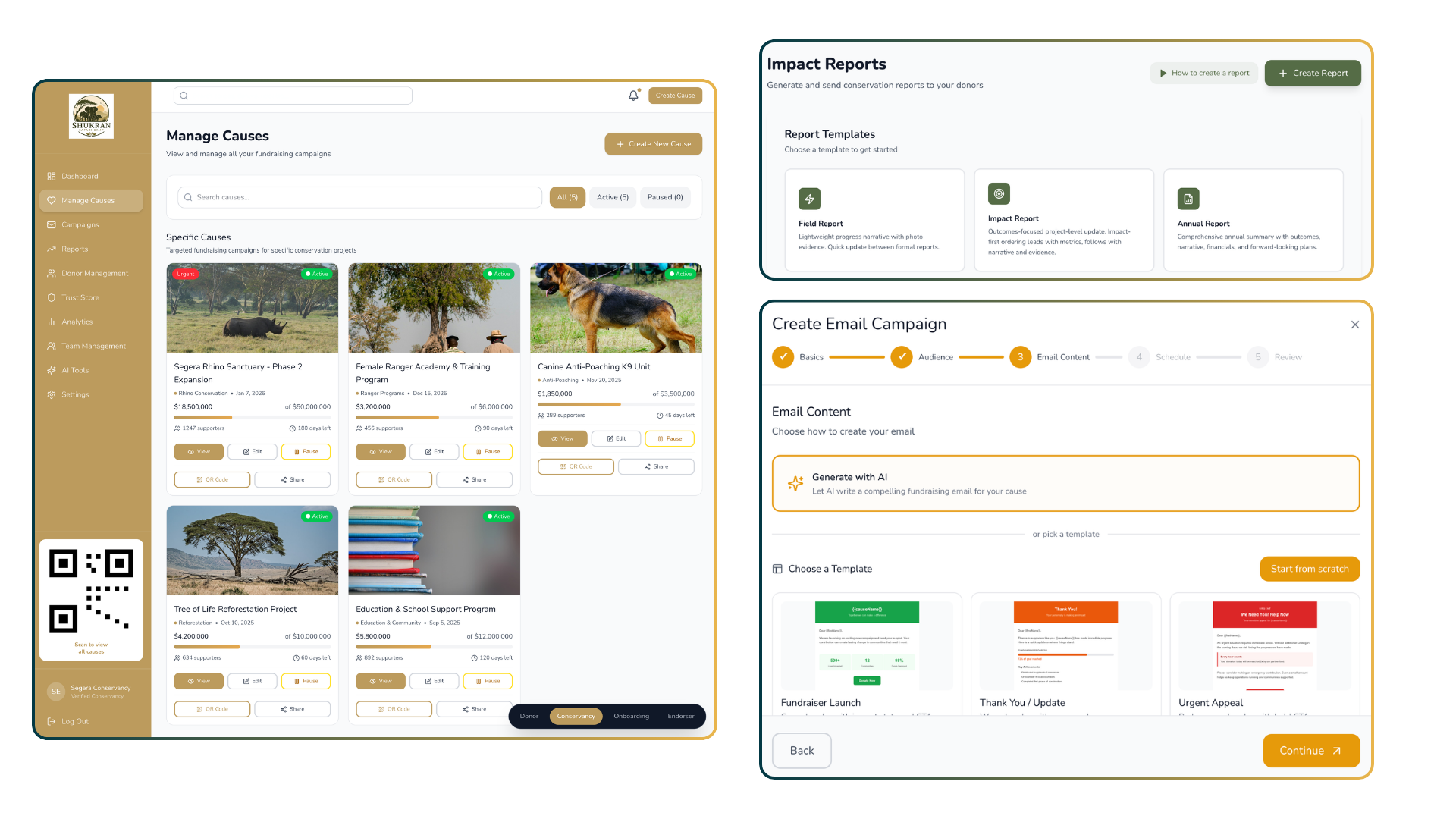
The platform uses a networked, white-label model that allows hospitality operators to operate their own branded fundraising environment while connecting guests to trusted conservation and community partners. Rather than asking every organization to build its own donor acquisition engine from scratch, DEP allows guest relationships already being created across the tourism ecosystem to become channels for sustained giving.
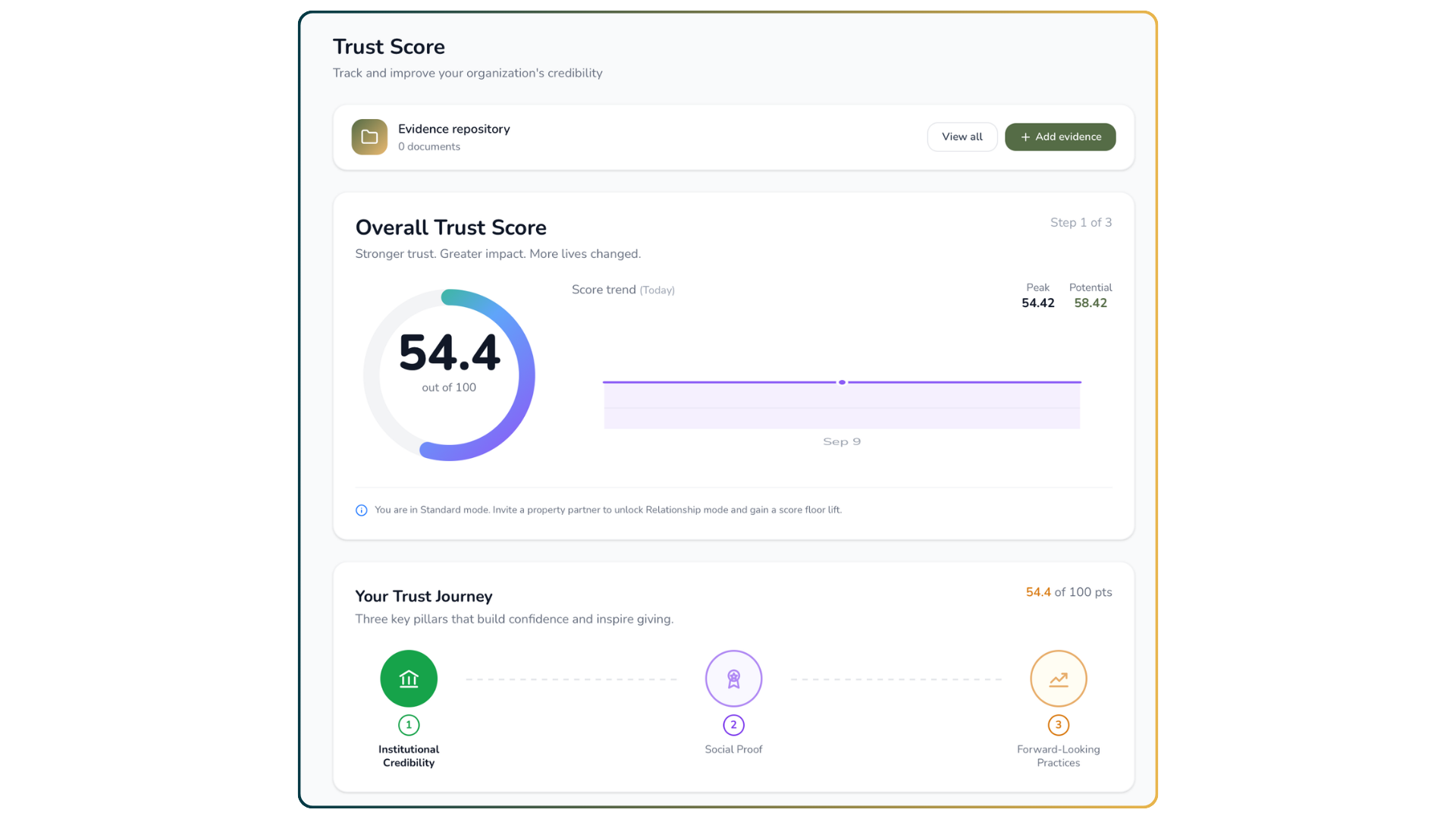
Trust is the second foundational layer. Our Trust Score makes transparency and accountability visible by evaluating institutional credibility, social proof and ongoing reporting practices. This gives operators greater confidence in the causes they choose to support and gives guests clearer signals about where their money is going.
The result is a more efficient funding ecosystem: operators activate the goodwill created through extraordinary guest experiences, conservation and community organizations gain access to a broader donor network, and guests have a trusted pathway to remain connected to the places and causes they care about.
The objective is not simply to facilitate a donation at checkout. It is to turn a moment of guest goodwill into a long-term donor relationship that can be cultivated, retained and compounded over time.
DEP then provides the fundraising infrastructure needed to support that relationship, including campaign pages, payments, donor communications, impact reporting, dashboards and analytics. Parallel to the technology, we partner with a Fiscal Sponsor to provide customers tax compliance receipting for their American donors.
From Millions to A Billion
Africa welcomed 81 million international tourists in 2025, and when you add the continent's growing domestic tourism market, the scale becomes extraordinary.
It increasingly seems clear to me that conservation and community initiatives across Africa are not constrained only by a lack of goodwill or resources. We are missing the alchemy that converts extraordinary travel experiences into sustained generosity.
Working alongside travel operators, conservationists and guests, I believe it is entirely possible to activate $1 billion in annual funding to the conservation frontlines across Africa, and I suspect that would only be the beginning.
If you are a travel or hospitality operator with guests who care deeply about the places they visit, if you run a conservancy or community organization and already have relationships with travel operators who believe in your work, we can help accelerate your fundraising and compound your donor base.
Let's talk: mark@shukran.co